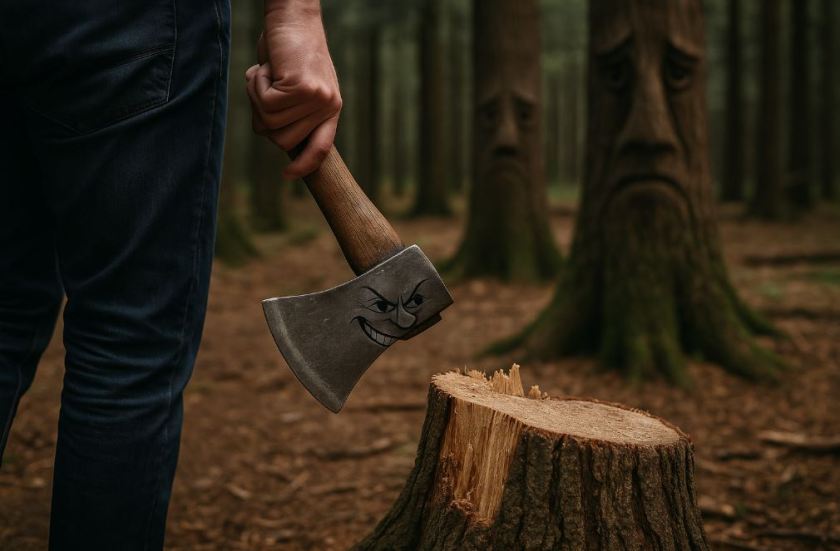
“The axe forgets, but the tree remembers.”
— African Proverb
There’s a proverb from Africa that says, “The axe forgets, but the tree remembers.” Simple words, but behind them lies a world of truth about hurt, history, and the way memory lingers in people and communities long after the moment has passed.
When an axe strikes a tree, the wood carries the scar. The bark splits, the mark remains. But for the axe? It’s just another swing. Another day. Another cut. The axe is put back on the shelf without thought of what it has left behind. Life moves on for the axe, but not for the tree.
Personal Wounds That Linger
We’ve all been trees at some point. We’ve all carried scars left by words, actions, or betrayals that the other person may not even recall. Someone lashes out in anger, makes a joke that cuts deep, or breaks a trust — and then forgets. For them, it was just a moment. But for you, it was a wound.
That’s the nature of being human. The harm-doer has the privilege of forgetting, while the harmed is often left carrying the weight. The axe doesn’t remember, but the tree lives with every strike.
Families, Friends, and Forgotten Cuts
Think about family. The parent who said something cruel to a child in frustration. The sibling rivalry that turned into resentment. The partner who made a promise they never intended to keep. For the axe, these things fade quickly. “I don’t even remember saying that.” But the tree remembers. The words echo. The trust breaks. The wound shapes how that person grows.
This proverb reminds us: we need to be careful about how we swing our words, our tempers, our choices. Because what’s fleeting for us might last forever for someone else.
Communities and Collective Memory
On a larger scale, this proverb isn’t just about individuals — it’s about peoples. Entire communities carry the memory of harm long after the world has tried to forget.
Colonialism. Slavery. Segregation. Jim Crow. Redlining. Police brutality.
For centuries, the “axes” of history have swung, and in many places, those who swung them have tried to move on. “That was a long time ago.” “Why bring it up now?” “Let’s just forget.”
But the trees remember.
The scars of generational trauma, systemic inequity, and cultural loss don’t disappear because time has passed.
This is why history matters. Why telling our own stories matters. Because until the tree speaks, the axe will always pretend it never struck.
Healing and Accountability
The proverb isn’t just about pain, though. It’s also about responsibility and healing. If you’ve ever been the axe — and we all have, at one time or another — it’s a call to humility. To remember that just because you’ve forgotten doesn’t mean the other person has.
The challenge is this: will we pretend our actions didn’t matter, or will we acknowledge the scars we’ve left and work to heal them? Sometimes, just recognizing the memory of the tree is the first step toward reconciliation.
And if you’re the tree? It’s a reminder that your scars are real, your memory is valid. But also, that trees still grow. They bear fruit. They provide shade. They thrive even with marks in their bark. The wound doesn’t define the whole story, but it is part of it.
The Power of Remembering
In a world that often tells us to “move on” or “forget about it,” this proverb stands tall as resistance. Memory is power. Remembering ensures that harm isn’t erased, that stories are told, and that justice is pursued.
The axe may forget. That’s its nature. But the tree remembers — and in that memory lies truth, legacy, and strength.
Closing Thought
Maybe the lesson for all of us is this: swing carefully. Speak carefully. Live carefully. Because what feels like nothing to you may last a lifetime for someone else.
And for those carrying scars — remember that even marked trees grow tall, strong, and beautiful.
The axe forgets, but the tree remembers. And maybe it’s the tree’s memory, not the axe’s forgetfulness, that will carry us forward.
Like what you read? Where do you stand — are you the axe or the tree?
If you can’t see the plight of others or how your actions affect them, maybe it’s time to ask yourself: have you ever been the axe?
Share your thoughts in the Comments below, and don’t forget to sign up at the bottom to receive email notifications for future posts from Kenny’s Camera, Cooking & Crazy Confessions at ZootsBlogSpot!
 Kenny's Camera, Cooking & Crazy Confessions!