Shocktober continues!
Stephen King fans may have noticed the recent wave of adaptations of his work, including The Long Walk, The Running Man, Welcome to Derry, and now, another adaptation of Carrie.
I was especially surprised to see Carrie getting another adaptation, considering how many times the story has already been brought to the screen. It makes you wonder whether Hollywood thinks it just hasn’t gotten it right yet. Or maybe it’s simply a testament to how incredibly awesome the original story is.
But here’s something I’ve always believed about adaptations: Just because something isn’t the same as the original doesn’t necessarily make it wrong. Some of you might remember that from my 2020 blog article, “Alex Haley’s Roots: Why the Remake Is Just As Important As the Original.” Sometimes it simply makes it different. And whether I like those differences is another matter entirely.
Having watched the new series, one of the things that impressed me most was the decision to expand Carrie into eight episodes instead of trying to tell the entire story in another two-hour movie.
And here’s why I think that matters.
Note: This commentary is based solely on a comparison between this miniseries and the events depicted in the original 1976 film, not Stephen King’s novel or any of the other movie adaptations.
The Advantage of Eight Episodes
At its heart, Carrie explores bullying, isolation, adolescence, and a young woman struggling to understand a world her mother has done so little to prepare her for.
A feature film has to move relatively quickly from one major event to the next, sometimes leaving us to imagine what happens between them. An eight-part miniseries, however, has the opportunity to explore those experiences in much greater detail.
We get more time to understand the characters, their relationships, their motivations, and the everyday circumstances that influence their decisions. We can follow the progression of events rather than simply witnessing the major turning points, and when one of the central themes of your story is bullying, that additional time can make an enormous difference.
The extended format also allows us to see how the consequences of someone’s actions can affect an entire community. What begins as a conflict between students can eventually involve parents, teachers, school administrators, and people who may have never even witnessed the original incident.
That’s one of the greatest advantages of telling this particular story over eight episodes.
For me specifically, it answers a very popular question: What happened between Carrie and the students between the initial bullying in the shower and the horrifying climax at the prom? A two-hour presentation can only show so much, whereas a mini-series takes the time to show us what she endures during the intervening months. We can’t simply assume that life was normal and without incident.
The Modernization Factor
Another thing I particularly appreciate about this adaptation is how much more believable the modernization makes the story.
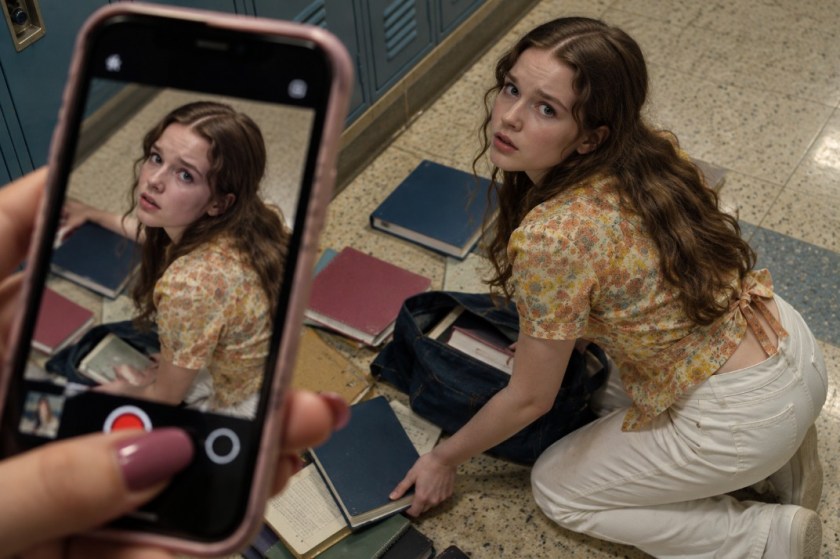
We’re living in an era of smartphones, social media, and live streaming. Something that happens in a classroom, a hallway, or practically anywhere else can be recorded and shared with hundreds, thousands, or even millions of people before those involved have had an opportunity to process what happened.
Bullying is no longer necessarily confined to a school building or the people who witnessed an incident firsthand. It can follow someone home, spread throughout a community, and reach people who have never even met the victim.
Note to self: Remember to give thanks to God that we didn’t have to deal with that in the ‘70s. I share a lot of mishaps in my blog tales, but some of them you all will NEVER know.
That’s where the expanded format becomes particularly valuable. We have an opportunity to see how these situations affect the students involved, their parents, the faculty, and the community at large.
And then there’s another disturbing element of modern technology: the ability to control the narrative.
With today’s editing tools, someone with malicious intentions can take footage of an incident, remove the surrounding context, rearrange what viewers see, or otherwise present the situation in a way that benefits the antagonist, often to the disadvantage of the victim.
Suddenly, the person being bullied is potentially dealing with an entire audience whose understanding of the situation has been manipulated. Once that version of events begins circulating, correcting the public’s perception can become a battle of its own.
That takes bullying to an entirely different level, especially when public opinion can be shaped by what people THINK happened rather than what actually took place.
The Difference Between Intelligence And Knowledge
Another important aspect of Carrie is the environment in which she was raised.
Carrie is the product of an extremely sheltered home. Her mother severely restricts her exposure to the outside world, including television, news, and other sources of information that most people take for granted. Even the books she’s permitted to read are limited to material her mother considers appropriate, safe, or free from sinful influences.
As a result, much of what happens in the world beyond her home is foreign to her.
And here’s the interesting distinction: Carrie is an intelligent young woman, yet she’s remarkably uninformed about ordinary experiences and situations that other people her age understand.
Intelligence and knowledge aren’t necessarily the same thing. You can possess the ability to understand something without ever having been given the opportunity to learn about it.
In Carrie’s case, that lack of exposure places her at an enormous disadvantage. She’s attempting to navigate adolescence, relationships, social expectations, and a rapidly changing world without many of the basic tools other teenagers have developed through everyday experience.
And it’s important to remember that Carrie isn’t simply the new student. She’s entering her sophomore year of high school after spending her entire life being homeschooled. In fact, this is her very first day attending school with other students. That social disadvantage is huge.
Now imagine placing someone with those disadvantages into today’s environment, where information travels instantly, public opinion can form in minutes, and a single embarrassing moment can potentially follow someone indefinitely.
That’s what makes the modernization of Carrie such an interesting storytelling opportunity. The world around her has changed dramatically, but because of the way she’s been raised, she’s hardly prepared to deal with it.
Understanding The Characters And Their Motivations
Perhaps the strongest quality of this new adaptation of Carrie is its character development, and I’m not simply talking about Carrie herself.
One of the advantages of having eight episodes is that we have more time to understand the people surrounding her, their motivations, their personal struggles, and the circumstances that influence their behavior.
Think about how often we watch a horror movie and encounter a character who’s simply cruel, malicious, or downright evil. We know they’re the antagonist because that’s how they’re presented to us, but we aren’t always given much opportunity to understand why they behave that way.
What experiences shaped their behavior? What circumstances influence their decisions? And what happens when those circumstances begin to change?
That’s something I particularly appreciate about this adaptation. Rather than simply presenting Carrie’s tormentors as cruel individuals, the story gives us opportunities to understand the circumstances behind their behavior, including the personal struggles and influences that contribute to their increasing malice and lack of empathy.
Understanding someone’s behavior doesn’t necessarily mean excusing it, but when we understand what motivates a character, we can better appreciate the decisions they make and the consequences that follow.
Case in point: Chris Hargensen. In the original film, she seems to be bad for no f’n reason. In this year’s version, she’s dealing with her parents’ marriage problems and money troubles that could affect where she goes to college. With all that going on and without much emotional support, it’s easy to see why she takes out her frustrations on the new kid.
And this extends well beyond the students.
The faculty must navigate their own difficult circumstances, attempting to address the bullying while dealing with parental involvement, community expectations, public scrutiny, and pressure from people who may have very different opinions about what should be done.
Suddenly, the situation becomes more complicated than simply identifying the bully and punishing them. We begin to see how different people respond to the same circumstances, sometimes making decisions that improve the situation and sometimes making decisions that make everything considerably worse.
Throughout the story, many of these characters face opportunities to do the right thing or the wrong thing. Their choices have consequences, those consequences affect other people, and those experiences influence the decisions they make going forward.
That’s what makes the character development so compelling to me. We’re given the experiences, pressures, motivations, and decisions that help explain why these people behave as they do.
Some characters may earn our sympathy.
Others may earn our empathy.
And some may leave us frustrated because we can see the choices they’re making and understand how those choices could affect everyone around them.
Real people aren’t always defined by one action, one personality trait, or one moment in their lives. They change, react, make mistakes, and sometimes learn from the consequences. Other times, they refuse to learn anything at all.
And that, to me, is the greatest strength of this adaptation. It gives us a perspective that helps us understand why things happen, why people behave the way they do, and how their actions influence everything that follows.
So, Does An Eight-Episode Miniseries Work For Carrie:
In my opinion, ABSOLUTELY!
I’ve read some viewer responses expressing concerns about the pacing, while others may consider the modernization too politically correct or, as some people like to call it, “woke.”
But to me, that’s part of what makes this adaptation work, because the situations and circumstances presented are relevant to the real world. These are issues that people deal with every day.
When you’re adapting a story originally set in the 1970s for an audience experiencing it more than 50 years later, I think it’s important to recognize how much the world has changed.
Technology has changed, the social environment has changed, and the ways people communicate, interact, and treat one another have changed. Yet some of the underlying problems remain painfully familiar.
Will you get the same ending as the original movie? That remains to be seen. But like I said before, no spoilers here, baby.
But trust me when I tell you, there’s a reason behind the choices these characters make, and the consequences of those choices help shape everything that follows.
And if there’s one thing I believe you’ll take away from this adaptation, it’s a greater appreciation of how our actions affect the people around us.
You may even walk away thinking twice about how we treat people in this world, and how we would want to be treated ourselves.
Like what you read? If you’ve seen it, do you agree? If you haven’t, I hope this encourages you to watch it sooner rather than later, because the spoilers are out there, posting memes and videos like it’s a contest!
Leave a comment below, and be sure to subscribe at the bottom (it’s free!) for future email notifications, including Part 2 of our Carrie Convo: 10 Things That Worked—and Didn’t Work. Straight from Kenny’s Camera, Cooking & Crazy Confessions at ZootsBlogSpot!

