LONG POST ALERT!
Well, here we are, folks! Welcome back to Part Two of our Carrie conversation!
In Part One, I explained why I thought expanding Stephen King’s classic story into an eight-episode miniseries was a good move. We discussed how the additional time allows us to explore the characters, their motivations, their relationships, and the consequences of their actions in ways that a two-hour movie could not.
And I stand by that assessment.
But y’all know me well enough by now.
Just because I believe the expanded format works doesn’t mean I agree with everything the filmmakers decided to do with it.
Remember something I said in Part One: Just because an adaptation does something differently from the original doesn’t necessarily make it wrong. Sometimes it just makes it different. Whether those differences make the story better is another matter entirely.
And now? You guessed it! We’re going to discuss those differences! Well actually, I’m gonna tell you. You hush and read.
I’ve put together ten things about this adaptation that I believe deserve particular attention: five things that worked and five things that didn’t. Some are relatively minor changes that made a surprising difference. Others fundamentally altered how I experienced the story.
And unlike Part One, we’re discussing EVERYTHING this time.
So, if you haven’t watched the miniseries yet and don’t want to know what happens, this is your opportunity to turn around, close the browser, catch up, and come back later.
Here Be Spoilers!
Out of respect for my readers, I’ve included a clickable Table of Contents below, listing all 10 points plus a bonus! Just click or tap whichever topic interests you, and you’ll be taken directly to that section. I’ve even included links to bring you right back to the Table of Contents when you’re finished!
Of course, if you’d rather read the entire article from beginning to end, enjoy!
One more thing: My comparisons are primarily with Brian De Palma’s original 1976 film, starring Sissy Spacek, rather than Stephen King’s novel or the other adaptations.
Five Things That Worked
- Carrie and Her Developing Powers — How the miniseries explores Carrie’s growing understanding of her extraordinary abilities.
- A Different Approach to the Prom Prank — A look at how the adaptation reimagines one of the story’s most infamous moments.
- Tommy Ross: More Than Just a Nice Guy — How additional character development changes our understanding of Tommy and his relationships.
- Bullying, School Accountability, and Margaret White — How the series addresses harassment, the responsibilities of school officials, and Margaret’s response.
- Chris and Tina: Understanding Two Troubled Characters — A closer examination of their motivations, relationships, and changing roles in the story.
Five Things That Didn’t Work
- Carrie and Emaline: A Complicated Relationship — Whether the addition of a new character changes the focus of Carrie’s story.
- Margaret White and the Mother-Daughter Conflict — How the adaptation handles one of the story’s most important relationships.
- The Carrie Red Account: Questions Left Unanswered — A closer look at the online controversy and how the school responds to it.
- Eight Episodes: How Much Is Too Much? — Whether the additional storytelling time always works to the adaptation’s advantage.
- The Mysterious Organization — How a new element expands the story beyond its familiar boundaries.
BONUS: Carrie and Emaline Ride Off Into the Sunset — How the miniseries transforms Carrie’s tragic ending into a new beginning, raising questions about what her future might hold.
Ok, you students who requested early dismissal are excused. For those who came for the dissertation, let’s get into it!
Carrie (2026), Pt. 2 of 2: 10 Things That Worked—and Didn’t Work (Warning: Contains Spoilers)
Five Things That Worked
1. Learning To Control Her Powers
One of the things I appreciated most about this version was the way Carrie learned to control her telekinetic abilities.
We’ve all seen movies in which someone discovers they possess supernatural powers. Usually, those powers manifest during moments of extreme emotional distress. Someone gets angry, objects start flying around the room, windows shatter, and folks take off running.
But what happens when that person actually learns how to CONTROL those abilities?
That’s where Emaline, our not-so-imaginary-friend, comes in. By the way, great twist: I’m real, no I’m not, actually I am.
Rather than simply allowing Carrie to discover her powers through a series of uncontrolled emotional outbursts, Emaline goes full-on Yoda and teaches her how to focus, concentrate, and direct her abilities toward specific objectives.
It reminds me of X-Men: First Class, when Charles Xavier helps Erik Lehnsherr (later known as Magneto) understand that his powers don’t have to be fueled exclusively by anger. With the proper focus, Erik can accomplish things he previously believed were beyond his capabilities.
Carrie experiences a similar transformation.
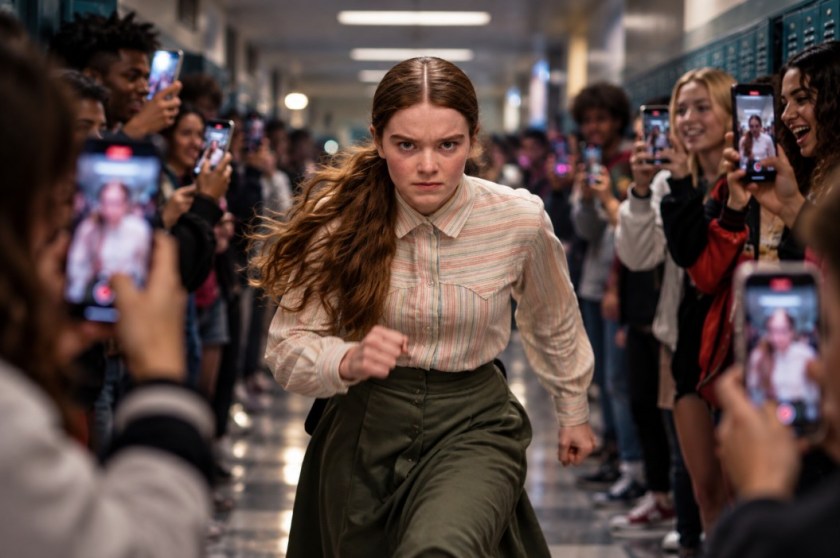
Let’s look at the cafeteria confrontation with Chris Hargensen. Carrie doesn’t lose her temper and cause Jell-O to fly around the room like the food fight scene from National Lampoon’s Animal House. She deliberately uses her powers to break Chris’s nose.
And then, in one of the series’ most talked about moments, she throws Chris’s own teasing phrases back at her: “Plug it up!”
Now that was payback!
But an even better demonstration occurs after Carrie confronts her mother, forces her into the prayer closet, and begins preparing to leave home.
Rather than manually gathering her belongings, Carrie calmly uses her telekinesis to collect her clothing and pack her backpack.
No anger. No panic. No dramatic explosion.
She’s simply using her abilities to perform an everyday task.
That little scene demonstrates just how far she’s come. Carrie isn’t merely discovering that she’s powerful. She’s learning how to USE that power.
But let me not forget my favorite scene of the series. After the shift in power, Carrie tells her mother she wants to go to prom. After some discussion, her mother asks, “And what if I say no?”
Without batting an eye—or changing that hilariously angry expression on her face—Carrie telekinetically opens the door behind herself as a reminder—or rather a warning—that she can put Margaret right back into the prayer closet.
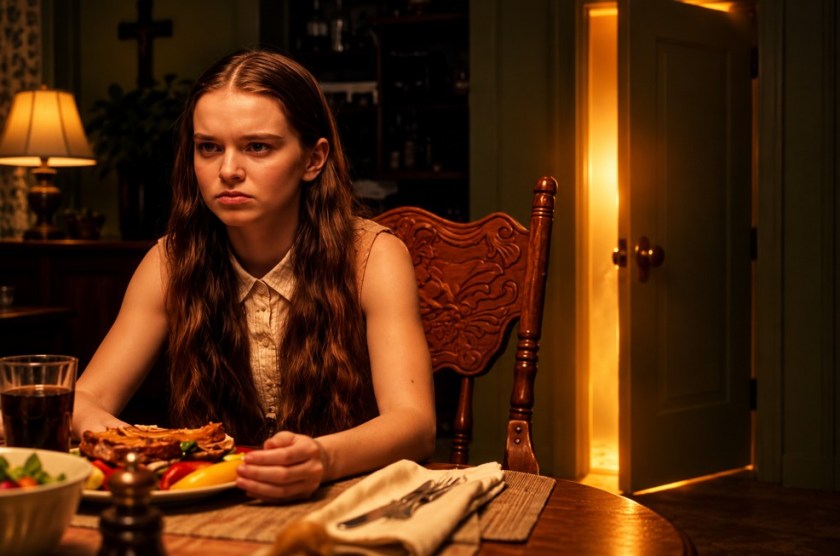
I swear, I screamed during that scene.
And that makes what happens later all the more interesting.
We’ll come back to that.
The force is strong in this one…
2. A More Believable Blood-Bucket Prank
On to one of the most iconic scenes in horror movie history.
The pig’s blood.
If you’ve seen the original Carrie, you know exactly what I’m talking about. If you’ve seen the other two versions of Carrie, you know what I’m talking about. If you’ve seen spoofs and Halloween costumes… well, you get it.
In the 1976 film, Chris Hargensen and Billy Nolan arrange for a bucket of pig’s blood to be positioned above the stage during the prom. Once Carrie is crowned queen, Chris pulls a rope that tips the bucket and sends its contents pouring down on her.
That’s just foul on so many levels.
But there’s something about the mechanics of that scene that has always required a considerable suspension of disbelief.
In order for this plan to succeed, Carrie has to be standing in precisely the right spot at precisely the right moment for the blood to land precisely on her.
And then the bucket itself falls, striking Tommy Ross in the head.
In other words, an awful lot depends on everything lining up perfectly.
The miniseries makes a relatively simple change that improves the entire sequence.
Instead of relying on a mechanically tipped bucket, Chris positions herself on the catwalk above the stage and personally pours the blood on Carrie.
Now the prank works because Chris is deliberately aiming at her target, rather than depending on Carrie standing on some imaginary X on the floor like some actor on a television set.
And there’s another improvement.
When Carrie retaliates against Chris using her telekinetic abilities, the catwalk collapses, causing the bucket to fall and strike Tommy.
That creates a more convincing chain of events.
Chris carries out the prank. Carrie strikes back. The structure collapses. Tommy becomes an unintended casualty.
It’s a relatively small adjustment, but it makes the scene more believable without sacrificing the horror of the original.
Sometimes you don’t have to reinvent an iconic moment.
You just have to rework the mechanics to make it an easier sell.
And unfortunately, the person who pays the highest price for that chain of events is someone who never deserved to be caught in it.
Which leads me to my next point…
3. Tommy Ross: The Good Guy Who Didn’t Deserve to Die
If anybody benefited from having eight episodes in which to develop, it’s Tommy Ross.
In the original movie, Tommy is presented as a decent young man. But much of his involvement with Carrie comes about because his guilt-ridden girlfriend, Sue Snell, persuades him to take Carrie to the prom.
And while his kindness toward Carrie appears genuine, there’s still something a little unusual about a teenage girl asking her boyfriend to take another girl to the biggest school event of her high school experience—other than graduation.
Let me rephrase that. That ain’t gonna happen, dude. My wife, who was my girlfriend at the time, couldn’t make it to a movie once and told me to take our mutual friend in her place. Of course, nothing happened, but she was pissed at me for several days for reasons she never revealed. She didn’t need to. I figured out why.

See how those secret tests work, fellas?
Anyway, the miniseries approaches that relationship differently.
Tommy and Sue have already broken up when Tommy independently decides to ask Carrie to the prom.
To me, that makes his invitation feel more natural. He’s not carrying out his girlfriend’s request. He’s making a decision for himself. She has no input.
But that’s only one example of Tommy’s character.
Earlier, when Sue experiences a pregnancy scare and doesn’t tell him about it, Tommy isn’t primarily upset about the possibility of becoming a father. He’s hurt because Sue didn’t give him the opportunity to support her.
Think about that.
Here’s a young man who genuinely wants to be there for someone he cares about, even when the circumstances are frightening and uncertain.
And when Sue eventually makes it clear that her plans for the future don’t include him romantically, Tommy doesn’t become bitter or vindictive.
He accepts her decision and assures her that they’ll remain friends.
Tommy, you’re a better man than most.
Later, when Sue is knocked down during the confrontation surrounding Chris Hargensen’s expulsion, Tommy rushes to her aid, picks her up, and carries her away from the disturbance.
This guy is practically Dudley Do-Right!
But I mean that affectionately.
The writers establish Tommy as a compassionate, loyal, considerate young man. His kindness toward Carrie isn’t some elaborate performance or an obligation he reluctantly accepts.
It’s consistent with the person we’ve already come to know.
Here’s a guy who goes to the prom with the simple intention of giving a lonely young woman an evening she can remember fondly for the rest of her life.
And THAT is why his death is so effective.
When Tommy is struck by the falling bucket, we’re not just watching another character die during a horror movie.
We’re watching someone who has repeatedly demonstrated genuine decency suffer a fate he did absolutely nothing to deserve.
And because we’ve spent so much time getting to know him, his death carries considerably more emotional weight.
Sometimes the best way to make a character’s death heartbreaking is to spend enough time showing us why that character deserved to live.
4. Bullying, Administrative Inaction, and Margaret White’s Use of Social Media
One of the strongest aspects of this adaptation is the way it illustrates how bullying can escalate when the people responsible for intervening fail to respond effectively.
Let’s return to Carrie’s humiliating experience in the girls’ locker room and examine what does—and doesn’t—happen afterward.
This young woman has just experienced her first menstrual period, something her mother never properly prepared her to understand. She’s frightened, confused, and surrounded by classmates who respond by throwing sanitary products at her.
Trivia: Notice how the episode titles reflect school-related themes? Episode One is titled “First Period”—a particularly fitting double meaning.
When the school administration becomes involved, Carrie is effectively placed in the position of identifying the people responsible before the school can pursue individual accountability.
Now, I’m not suggesting that every school administration would handle such an incident the same way.
My point is that the series demonstrates how inadequate intervention can allow an already terrible situation to become considerably worse.
Carrie is the victim, yet she’s being asked to shoulder much of the responsibility for holding her tormentors accountable.
I don’t know about you, but I think it’s difficult for students to identify their tormentors in a world where “I’ll see you after school” can be both a spoken threat and an unspoken terror. So let’s consider the possibility that Carrie might refuse to name names, which is exactly what happened.
And even if she wanted to cooperate, whom should she identify? It’s easy for individual students to deny participating. It’s also entirely possible that Carrie, frightened and overwhelmed by what was happening, couldn’t remember everyone involved.
That’s a real problem. But it shouldn’t prevent the adults from taking action.
The coach eventually punished the class, which at least demonstrated that the incident wasn’t being ignored. But by then, an opportunity for immediate intervention had already been missed.
Students were recording the humiliation on their phones. Why wasn’t more done to identify those recordings, preserve whatever evidence could reasonably be obtained, and investigate who participated?
I’m not suggesting that school officials had the right to seize and search every student’s phone. Students have rights, too. But surely there were investigative steps available that didn’t require violating anyone’s privacy.
And what about the parents?
I would have expected the school to contact the parents of students identified as participants and consider notifying the other families that a serious harassment incident had occurred, without revealing Carrie’s private circumstances or accusing students without evidence. That would at least give parents an opportunity to speak with their children about what happened.
Then there’s the question of notifying Carrie’s mother.
Ordinarily, an incident of this severity would warrant parental involvement. But given what we know about Margaret White, the school also needed to consider whether contacting her might expose Carrie to further harm at home.
This was not some harmless schoolyard prank. A frightened young woman was humiliated in front of her classmates during an intensely personal experience.
Why wasn’t there an immediate, structured investigation? Why weren’t the students spoken to individually? And why wasn’t Carrie offered meaningful support and protection against retaliation?
Beyond investigating the incident, the school could also have addressed the entire class about harassment, humiliation, and the responsibility of bystanders. Such a discussion wouldn’t require treating every student as equally guilty.
I’m not suggesting that every student should have been punished simply for being present. Nor should innocent students have been threatened with exclusion from prom to force someone to confess. But students found responsible, following a fair investigation, could certainly have faced appropriate consequences under school policy.
This was a difficult situation to navigate. I recognize that.
But difficulty is not an excuse for inaction.
And the consequences don’t end with that initial incident.
The conflict escalates. Other students become involved. Parents enter the picture. Public opinion begins to shift. What started as a humiliating encounter in a locker room becomes a controversy affecting the broader community.
As the school’s response becomes part of that controversy, another character enters the public debate in a way I didn’t expect: Margaret White.
Margaret has spent years rejecting much of modern society.
She’s suspicious of outside influences, distrustful of institutions, and determined to control what enters her household. Even the family’s locked mailbox reflects that mentality.
Yet when she believes the school is failing to protect Carrie, what does she do?
She turns to social media!
The very type of modern technology that someone with Margaret’s worldview might ordinarily reject suddenly becomes a useful weapon.
And that’s what makes this development interesting.
Margaret hasn’t necessarily changed her beliefs about the outside world. She’s simply discovered that one of its tools can serve her purposes.
The contrast is fascinating.
On one side, we have a school administration struggling or failing to address a growing problem.
On the other, we have a woman who distrusts modern society but is perfectly willing to use its technology when doing so advances her agenda.
The irony works, and it gives Margaret an additional dimension beyond the controlling, religiously fanatical mother we’ve come to know.
5. The Making and Unmaking of Two Villains: Chris and Tina
Here’s something I’ve always appreciated about a well-written antagonist.
It’s one thing to show us that someone is cruel.
It’s another thing entirely to show us WHY.
In the original Carrie, Chris Hargensen is essentially the mean girl who makes Carrie’s life miserable. We know she’s cruel because that’s how she behaves, but we don’t spend much time exploring the circumstances that shaped her.
The miniseries changes that.
Chris is dealing with a household that’s falling apart. Her parents’ marriage is collapsing, her family’s financial circumstances are deteriorating, her vehicle gets repossessed, and the future she expected for herself is becoming increasingly uncertain.
Her anger doesn’t originate with Carrie.
Carrie just becomes a convenient target.
That distinction matters because understanding someone’s behavior isn’t the same as excusing it.
Chris is still responsible for the cruelty she inflicts on Carrie. But now we can see how her personal frustrations contribute to her increasingly destructive behavior.
And during a private bathroom conversation, Carrie confronts her with a remarkably simple question: Why are you so cruel to me when I’ve never treated you that way?
For a moment, Chris seems genuinely unable to explain herself.
There’s an opportunity for understanding. Perhaps even reconciliation.
Unfortunately, that opportunity doesn’t last.
Once the girls return to their meeting, outside influences help reignite the hostility, and the possibility of reconciliation disappears.
But Chris isn’t the only antagonist whose journey deserves attention.
Let’s talk about Tina.
Tina desperately wants to become part of Chris’s popular circle. Chris treats that desire almost like a joke, setting social-media expectations that Tina has to meet before she can be accepted.
As Tina becomes increasingly frustrated by her inability to gain Chris’s approval, something changes.
Instead of continuing to beg for acceptance, Tina begins maneuvering to replace Chris.
She contributes to the tensions surrounding Chris, encourages conflicts, and ultimately benefits when Chris is expelled, losing her position within the school’s social hierarchy.
Before long, Tina has her own entourage.
She’s even approaching Tommy Ross about accompanying her to the prom, presenting the invitation as though she’s doing HIM a favor.
“This queen needs a king!”
And just like that, the girl who so desperately wanted to belong to the popular crowd now runs it.
The queen is dead. Long live the queen!
(And unlike Chris, Tina didn’t need a coronation. She just needed a vacancy.)
What I find particularly interesting is that both Chris and Tina eventually experience moments when they appear to recognize the cruelty of their actions.
At the prom, Tina has a surprisingly pleasant exchange with Carrie. Carrie reveals that she voted for Tina, and Tina compliments Carrie’s appearance.
For a moment, Tina seems to recognize that the girl she’s helped torment has never actually done anything to deserve it.
When Tina realizes Chris is about to carry out her terrible prank, she sends a quick text, urging her not to go through with it.
Chris later has her own moment of apparent remorse shortly before her death.
After witnessing the consequences of the night’s events and realizing that her own life is in danger, she attempts to apologize to Carrie.
But is that genuine repentance?
Or is it what I would call worldly sorrow rather than godly sorrow—regret driven by the consequences of one’s actions rather than a deeper transformation of the heart?
That’s an interesting question, and one worth exploring further.
What matters here is that the miniseries gives both characters something more than simple villainy.
We see their motivations, their ambitions, the choices they make, and the consequences that follow.
And by the time they recognize what they’ve done, their opportunities to make things right have largely disappeared.
Too little. Too late.
There’s actually enough material involving these two characters to warrant an entire discussion of its own.
And who knows? We might revisit them someday.
For now, let’s move on to the things that didn’t work.
FIVE THINGS THAT DIDN’T WORK
6. Emaline Steals Carrie’s Thunder
Remember how I praised Emaline for teaching Carrie to control her powers? Well, here’s where I have a problem with what the writers ultimately decide to do with that relationship.
Throughout the story, Carrie is subjected to bullying, humiliation, intimidation, and abuse. Her classmates torment her. Her mother controls her. The people around her repeatedly deny her the opportunity to make decisions about her own life.
And as Carrie gradually learns to control her telekinetic abilities, we begin to see her gain something she’s never truly possessed.
Power over her own circumstances.
But when the story reaches its climax, much of that power is shockingly transferred to Emaline.
Initially, Emaline seems almost like an extension of Carrie’s personality—a manifestation of the anger and resentment Carrie has spent years suppressing.
Under that interpretation, allowing Emaline to take control could still represent Carrie surrendering to the darker side of herself.
But the revelation that Emaline is an actual person changes the meaning of that decision.
Now, instead of Carrie personally carrying out the revenge that her suffering has been building toward, Emaline assumes control of much of the destruction.
That didn’t sit well with me—or, from what I’ve read online, a lot of other viewers.
The original story is horrifying precisely because Carrie’s retaliation comes from Carrie herself.
We may understand why she’s angry without condoning the terrible things she does. Her revenge is simultaneously frightening, tragic, and deeply personal.
But in the miniseries, Carrie effectively hands over responsibility for much of that retaliation to someone else.
And here’s the irony.
After spending her entire life being controlled by other people, Carrie finally learns how to control her own powers.
Only to surrender control to Emaline when it matters most.
I don’t object to Emaline’s friendship with Carrie. In fact, I think that relationship is one of the adaptation’s more interesting additions.
My problem is that the writers spend so much time developing Carrie’s independence, only to undermine it during the most important events of her story.
Emaline helps Carrie find her voice, only to arguably take it away at the climax.
7. Margaret White’s Death: The Wrong Person Delivered the Final Blow
Margaret White is Carrie’s first and most persistent bully.
Long before Carrie encounters Chris Hargensen or any of her other classmates, she’s already been subjected to years of religious intimidation, emotional abuse, and physical punishment at home.
Margaret controls what Carrie reads, what she learns, how she behaves, and how she’s expected to respond whenever she questions her mother’s authority.
And whenever Carrie challenges something Margaret says or does, what’s the response?
Pray!
Rather than addressing her daughter’s questions, Margaret treats them as evidence of sinfulness and forces Carrie into the prayer closet.
That closet becomes a symbol of the prison in which Carrie has spent much of her life.
In the original 1976 film, Margaret’s eventual death provides a fitting conclusion to their relationship.
When Margaret attempts to murder Carrie, Carrie fights back using her telekinetic powers.
It’s a horrifying confrontation, but the conflict is resolved by the two people whose relationship has defined so much of the story.
And when the house ultimately collapses, there’s an additional element of poetic justice.
The very home Margaret used to imprison and control her daughter becomes the instrument of her own destruction.
Margaret dies in the prison she created.
But the miniseries takes a different approach.
Margaret survives the collapse of the house, revealing supernatural abilities of her own that allow her to escape what appeared to be certain death.
That revelation raises another question: If Margaret possesses similar abilities, could that change how we understand Carrie’s extraordinary gifts?
But my greater objection concerns what happens afterward.
Margaret is eventually killed by the unidentified woman interviewing her during the epilogue, someone connected to the mysterious organization introduced into the story.
The woman uses her abilities to slow Margaret’s heartbeat until it stops.
Margaret realizes what’s happening, and in her final moments, she’s reduced to praying as she faces her own death.
Now, there’s certainly an irony in seeing Margaret, who spent years controlling Carrie through fear and religious intimidation, become frightened and powerless herself.
But the problem is that Carrie has absolutely nothing to do with it.
And that deprives their relationship of the resolution I believe it deserved.
It reminds me of the series finale of Angel. (Warning: Spoilers!)
After years of antagonizing Angel, Lindsey McDonald is furious when Lorne shoots him. Lindsey believes that Angel, his longtime adversary, should have been the one to kill him.
His reaction illustrates how much the identity of the person delivering the final blow can matter.
Margaret’s death presents a similar problem.
It’s not simply that she dies.
It’s that she dies at the hands of someone who has no meaningful relationship with the abuse she inflicted on Carrie.
The writers had an opportunity to bring the mother-daughter conflict to a deeply personal conclusion.
Instead, they gave that moment to somebody else.
And to me, that’s a missed opportunity. In fact, I ended up feeling sorry for her.
I didn’t wanna feel sorry for that heifer!
Woosahhh…
8. The Carrie Red Account: Why Wasn’t It Investigated Further?
Here’s a storyline that left me with some serious questions.
The malicious social-media account known as Carrie Red becomes a major source of conflict throughout the miniseries.
Its activities contribute to public humiliation, accusations, disputes, and confrontations involving multiple students and members of the school community.
And the consequences become increasingly serious.
At one point, Sue provides the principal with an audio recording that appears to implicate Chris Hargensen in operating the account.
Chris denies responsibility, including the circumstances surrounding the recording.
Her father aggressively challenges that the audio could have been fabricated or manipulated using artificial intelligence.
And that is definitely a legitimate concern in today’s world.
We live in an era when audio and video recordings can be altered, manufactured, or presented misleadingly. Simply possessing a recording doesn’t automatically establish its authenticity.
But here’s my question.
Why does the investigation seem to stop there?
The principal appears to believe Chris is responsible but suggests that little can be done without an admission or stronger proof.
And that’s where I began having difficulty accepting the way the storyline was handled.
We’re not talking about a harmless prank account that posted a few embarrassing photographs.
We’re talking about an online operation associated with serious accusations, school disturbances, damaged reputations, and eventually a suicide.
Now, to be clear, the existence of that tragedy doesn’t automatically prove that a particular person committed a crime or that the account directly caused the death.
Nor am I suggesting that the police could simply seize everyone’s phones, retrieve an IP address, and immediately identify the culprit.
Real investigations require evidence, appropriate legal procedures, and sufficient grounds to obtain private records.
But dude, come on… there were other investigative possibilities worth considering.
Could relevant online evidence have been preserved? Could the account’s activities have been examined more thoroughly? Were there circumstances that warranted involving law enforcement or seeking assistance from the platform?
And even if the suicide occurred after the principal’s confrontation with Chris, wouldn’t that tragedy provide reason to revisit the entire matter?
That’s my criticism.
Not that the school necessarily could have proven Chris was responsible.
Not that the authorities would have been guaranteed to solve everything.
But that the story raises the stakes so dramatically without convincingly showing why additional investigative avenues weren’t pursued or considered.
And here’s why that’s important.
Earlier, I praised the miniseries for demonstrating how inadequate administrative responses can contribute to bullying and escalating conflict.
I still believe that works.
But there’s a difference between effectively portraying institutional failure and leaving viewers wondering why the people involved appear to overlook reasonable next steps.
For me, the Carrie Red storyline crosses into that second category.
9. When Eight Episodes Become Too Much of a Good Thing
Now, here’s where I’m going to contradict something I said in Part One.
Remember how enthusiastic I was about the decision to expand Carrie into eight episodes?
Well, I still believe the additional time benefits the story.
But there’s a downside.
It results in me writing these long-ass blog posts!
Kidding. Not kidding. But seriously…
You know that famous line about how you either die a hero or live long enough to see yourself become the villain?
I’ve sometimes applied that idea to public speaking and training.
When you’re giving a presentation, you can stick to your material, make your points, and leave your audience satisfied.
But the longer you keep talking, the more opportunities you create to say something that doesn’t quite land the way you intended.
Sometimes knowing when to stop is just as important as knowing what to say.
And I think something similar happens with Carrie.
The eight-episode format gives the writers an opportunity to explore Carrie’s daily experiences, develop her relationships, and show how her circumstances change between the initial locker-room humiliation and the prom.
But it also creates opportunities for Carrie to experience victories along the way.
And those victories fundamentally change how I perceive her by the time we reach the climax.
Let’s jump back to the original 1976 film… again.
Sissy Spacek portrays Carrie as a painfully isolated young woman. She’s awkward, socially inexperienced, frightened of her mother, and seemingly rejected or ignored by practically everyone around her.
Even when someone treats her kindly, she’s understandably suspicious.
She’s the ultimate underdog.
So when the pig’s blood comes pouring down on her at the prom, the humiliation feels like the final unforgivable act against someone who has already endured more than enough.
We sympathize with her, even as her retaliation becomes horrifying.
But in the miniseries, Carrie’s circumstances evolve considerably.
She begins to develop friendships. Some students come to her defense. Public opinion becomes divided rather than uniformly hostile.
She also begins standing up for herself.
When she breaks Chris Hargensen’s nose and throws Chris’s own words back at her, that’s a victory.
When she confronts Margaret, forces her into the prayer closet, and tells her that SHE needs to repent, that’s another victory.
And Margaret eventually acknowledges that she’s afraid of Carrie.
Think about the significance of that.
The woman who has terrorized Carrie throughout her life is now frightened of her own daughter.
Carrie is no longer quite the helpless young woman we met at the beginning.
And as the controversy surrounding Chris escalates, Carrie gains additional support while Chris suffers increasingly serious consequences, including expulsion.
By the time we arrive at the prom, Carrie has already experienced several moments of empowerment.
Look, I’m not suggesting that those victories erase the cruelty she’s endured or that she no longer deserves our sympathy.
Of course she does.
But the emotional balance has shifted.
In the original film, Carrie seems almost completely defenseless until the moment she finally retaliates.
In the miniseries, we’ve watched her learn to fight back. We’ve even cheered along the way.
So, when the blood comes pouring down, part of me is almost thinking, “Go ‘head, girl! Handle yo’ business!”
That’s a very different emotional reaction.
And I think it makes the tragedy somewhat less devastating.
The additional character development makes Carrie stronger, more capable, and more independent.
Those are positive qualities for a character.
But they also make her feel less like the utterly isolated victim whose suffering defined the original film.
In other words, the very thing that makes eight episodes advantageous can also weaken one of the original story’s greatest emotional strengths.
The more victories Carrie experiences before the prom, the less overwhelming her final humiliation feels.
And that, to me, is one of the risks of expanding a story that originally depended so heavily on the cumulative suffering of its central character.
End result? Unlike Carrie, the story lives long enough to see itself become the villain.
And now, finally…
10. The Secret Organization: When a New Story Takes Over
My final major criticism.
The mysterious organization introduced into the miniseries.
And apparently, the story isn’t finished yet. On October 22, Prime Video officially renewed Carrie for a second season. Mike Flanagan has even expressed his desire to make it a three-season story.
I understand what the writers may have been attempting to accomplish.
By revealing that other people possess supernatural abilities and introducing an organization interested in identifying or controlling them, the story suddenly becomes part of a much larger world.
That opens the door to all kinds of possibilities.
Who are these people?
How long have they existed?
What do they want?
How many other individuals possess abilities similar to Carrie’s?
Why did they ask Margaret to identify Emaline’s photo? Is she a defector from the group, or someone they’re looking to recruit?
And what happens next?
Points to ponder.
But here’s my problem.
They aren’t the questions I expected to be asking at the conclusion of Carrie.
The original film is a relatively self-contained tragedy.
A sheltered young woman is bullied, humiliated, and abused. She discovers extraordinary powers, experiences a brief moment of happiness, suffers one final devastating humiliation, and unleashes a catastrophic retaliation.
Her story ends tragically.
We may be left emotionally shaken, but we understand the story we’ve just watched.
The miniseries, however, introduces an entirely new entity that begins competing for our attention.
Suddenly, the story is no longer focused solely on Carrie, Margaret, Chris, Sue, Tommy, and the consequences of their actions.
We’re wondering about a secret organization, its agenda, its abilities, and its possible role in future events.
Even Margaret’s survival and previously unrevealed supernatural abilities contribute to this larger mythology.
What originally seemed extraordinary about Carrie begins to look like one piece of a much broader supernatural phenomenon.
Maybe that’s exactly what the filmmakers wanted.
But for me, it changes the focus of the story at precisely the moment when I wanted the emotional consequences of Carrie’s experiences to take center stage.
Instead of allowing Carrie’s tragedy to reach its conclusion, this version seems particularly interested in introducing another storyline. And as I mentioned before, we got another season.
Now, I have no objection to filmmakers exercising creative freedom.
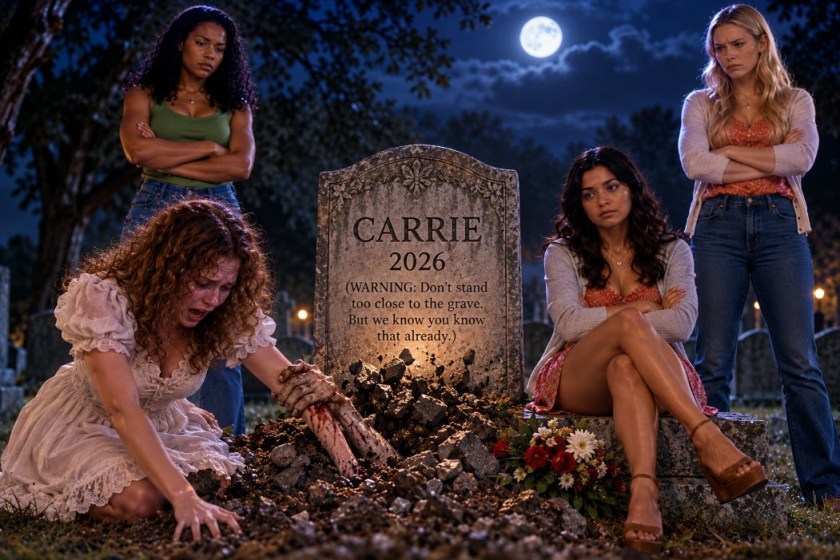
And I certainly don’t believe every adaptation must end exactly as its predecessor did. I mean, hey, the iconic hand emerging from the grave final scene is no longer particularly scary and has been run into the ground—pun intended.
But I do believe that when you introduce an entirely new mythology, you have to consider whether it strengthens the story you’re telling or distracts from it.
In this case, I think it distracts.
The organization raises more questions than it answers, and those questions shift our attention away from the very character whose experiences brought us here in the first place.
And that brings me to one final observation.
Y’all thought I was finally gonna let you go to bed. Didn’t you?
BONUS: Carrie and Emaline Ride Off Into the Sunset
Okay, I know I promised ten points. But you know me. Sometimes there’s just ONE MORE THING that needs to be said! And this one concerns the ending itself.
In the original, Carrie White’s story is a tragedy.
She suffers unimaginable humiliation, retaliates with devastating consequences, loses her mother, and ultimately dies.
There’s no riding off into the sunset.
No new beginning.
No suggestion that she’s about to embark on a series of exciting adventures.
It’s a heartbreaking conclusion to the life of a young woman who never really had a fair chance.
But the miniseries takes a radically different approach.
Carrie survives (as she does in the 2002 TV movie). Emaline survives. And the two of them essentially ride off into the sunset together.
Now, instead of a tragic ending, we have something that feels almost like the conclusion of a superhero origin story.
Carrie has discovered her powers, learned how to control them, confronted her tormentors, escaped her abusive home, and found someone who understands her.
She’s no longer simply the frightened, isolated girl we met at the beginning.
She’s now a young woman with unfathomable abilities and an uncertain future.
In many respects, we’ve moved from tragedy into a coming-of-age story. And while there’s nothing wrong with that, it’s an entirely different emotional experience.
The original leaves us mourning Carrie White.
The miniseries leaves us wondering what Carrie might do next.
Will she encounter other people with supernatural abilities?
Will the mysterious organization continue pursuing her?
Will she and Emaline face new threats?
Are we watching the conclusion of a story—or the beginning of another?
Is Kenny going to keep his promise and bring this blog to a close after this point?
That’s probably the most significant difference between the two adaptations: One closes the book on Carrie White’s life. The other seems to be opening an entirely new chapter.
Whether that’s a good thing depends on what you wanted from the story in the first place. Personally, I can appreciate the creative ambition while still questioning whether something essential was lost along the way. But I suppose we’ll have to wait and see what the filmmakers intend to do with Carrie’s adventures in Season Two.
And speaking of continuing a story…
Remember our discussion about Chris Hargensen and Tina? I have a funny feeling there’s a lot more to say about those two.
Perhaps we haven’t heard the last of them, either.
After all, who says this Carrie conversation has to end here? Oh Lord…
So, there you have it! Five things I thought worked, five things I thought didn’t, and one bonus observation for good measure.
Did the eight-episode format improve Carrie? In several important ways, I believe it did.
Did every creative decision strengthen the story? Not in my opinion.
But that’s what makes adaptations worth discussing. We can appreciate the things they accomplish while questioning the things they change.
And sometimes the most interesting conversations aren’t about whether something is good or bad.
They’re about WHY it works—or why it doesn’t.
Have you watched the new Carrie? Do you agree with my observations, or do you see things differently? Leave a comment below, and be sure to subscribe (it’s free!) for future posts and more of Kenny’s Camera, Cooking & Crazy Confessions!


One comment